Meshtastic: First Thoughts
I recently tried out Meshtastic, an open source, off-grid, decentralized, mesh network built to run on affordable, low-power devices. Let’s take a look at my preliminary experiences.
The What, Why, and How
Let’s quickly cover what Meshtastic is, why I’m excited for it, and how I want to utilize this awesome technology.
What is Meshtastic?
I first discovered Meshtastic when Jeff Geerling made a video on it and I instantly fell in love. Check out his video for a quick overview, or see the Meshtastic website for a deep-dive.
An open source, off-grid, decentralized, mesh network built to run on affordable, low-power devices
The main quote from Meshtastic.org perfectly sums up the goal behind Meshtastic and the reasons I was initially drawn to it. Meshtastic essentially allows users to utilize inexpensive LoRa radios as an off-grid communication platform. With the correct devices, and keyboard inputs, you can communicate directly between two LoRa enabled devices with no external devices involved. A more common way to communicate is to pair a Meshtastic device to a phone through Bluetooth, this allows use of the Meshtastic app to text in a phone-to-phone UX with traffic going through the LoRa radios.
Meshtastic allows for long range communication, a maximum record of 254 km has been recorded. Communication is completely decentralized through a mesh network, you can utilize encrypted communication, and you can even share GPS for location based features and tracking.
Why do I care about Meshtastic?
Well first off, Jeff Geerling made a video on it, obviously I have to try it!
In all seriousness though, I’m just super nerdy and love working with technology, especially new things. This may be the largest appeal for me. Also, the world is a very fucked up place, you can’t turn on the news (local, national, or world) without seeing some kind of pain and suffering by people just wanting to live their lives. I have a small family, but if anything every happened (i.e: nuclear or EMP attacks, government takeover of communication networks, etc.) I most definitely want to be able to communicate with my wife and know where she is through the GPS functionality.
Meshtastic promises that. A group can build out a mesh network covering an entire city, multiple cities, with the MQTT integrations, the communication can even reach worldwide levels, although this last option would not work in a SHTF scenario which is what I most want to accomplish.
How will I use Meshtastic?
As I briefly mentioned above, I want to use Meshtastic to both nerd-out and communicate with friends as well as get a setup for my wife so we can communicate in a scenario without traditional (phone, internet, etc.) options. Although GMRS radios would potentially be a similarly valid options, I was drawn to the new technology as well as the ability to have legally encrypted communication.
To that end, I would like to have two main client devices, one for myself and one for my wife, this will allow us to each pair one to our phones and be able to communicate with each other through an encrypted channel. Eventually, I would like to add in at least one router/repeater. My initial goal will be a fully solar-powered node that I can mount fairly high above my backyard that could be self-sufficient and allow me to reach further locations. Eventually I could expand with more repeaters throughout the city for a robust mesh network, even stealthing some installs on top of taller buildings.
I’m still looking into how I want to accomplish an outdoor repeater but the RAK WisBlock Harbor Breeze mod looks very promising. With my 3D printer I will be able to print a mount that will allow me to stick it on a small antenna pole or similar and raise it as high as possible in my back yard. There’s an old but still-in-use radio tower of some sort a hundred yards or so from my house, maybe I can make a solar node with a battery mount and use a drone to stick it on top of the tower.
Getting Started
Muzi Works
I purchased my first Meshtastic devices through Muzi Works. This is the company that sent Jeff Geerling the samples he reviewed in his video, which initial brought my attention to Meshtastic. I don’t like to plan things, and absolutely love making impulse purchases so I jumped at the quickest opportunity I had. Let’s cover the two devices and why I chose them initially. Keep in mind, I purchased the kits without the cases since I have a 3D printer and Muzi Works is kind enough to make the STLs for their cases free to download from Printables.
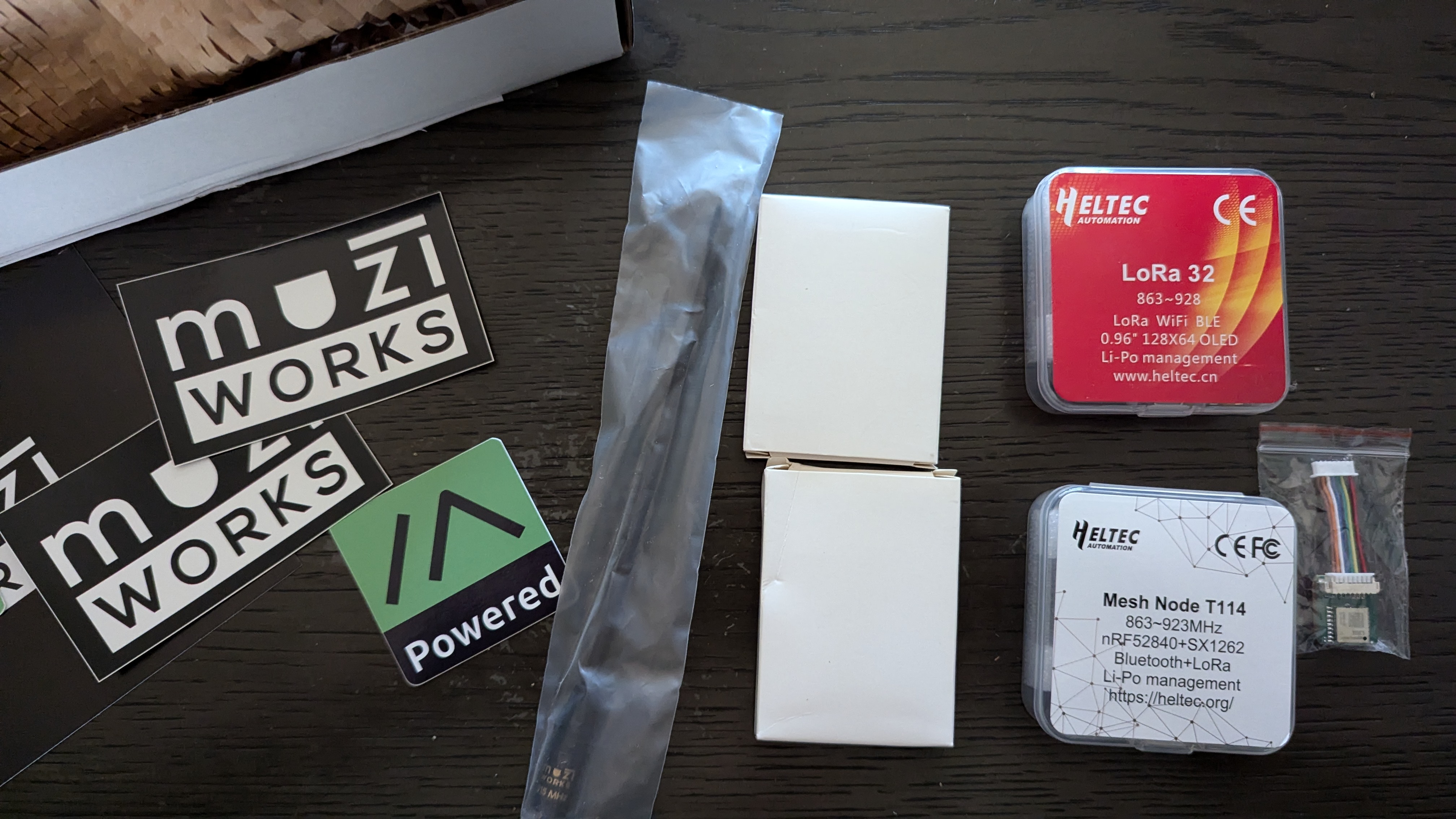 The devices purchased first, complete with stickers!
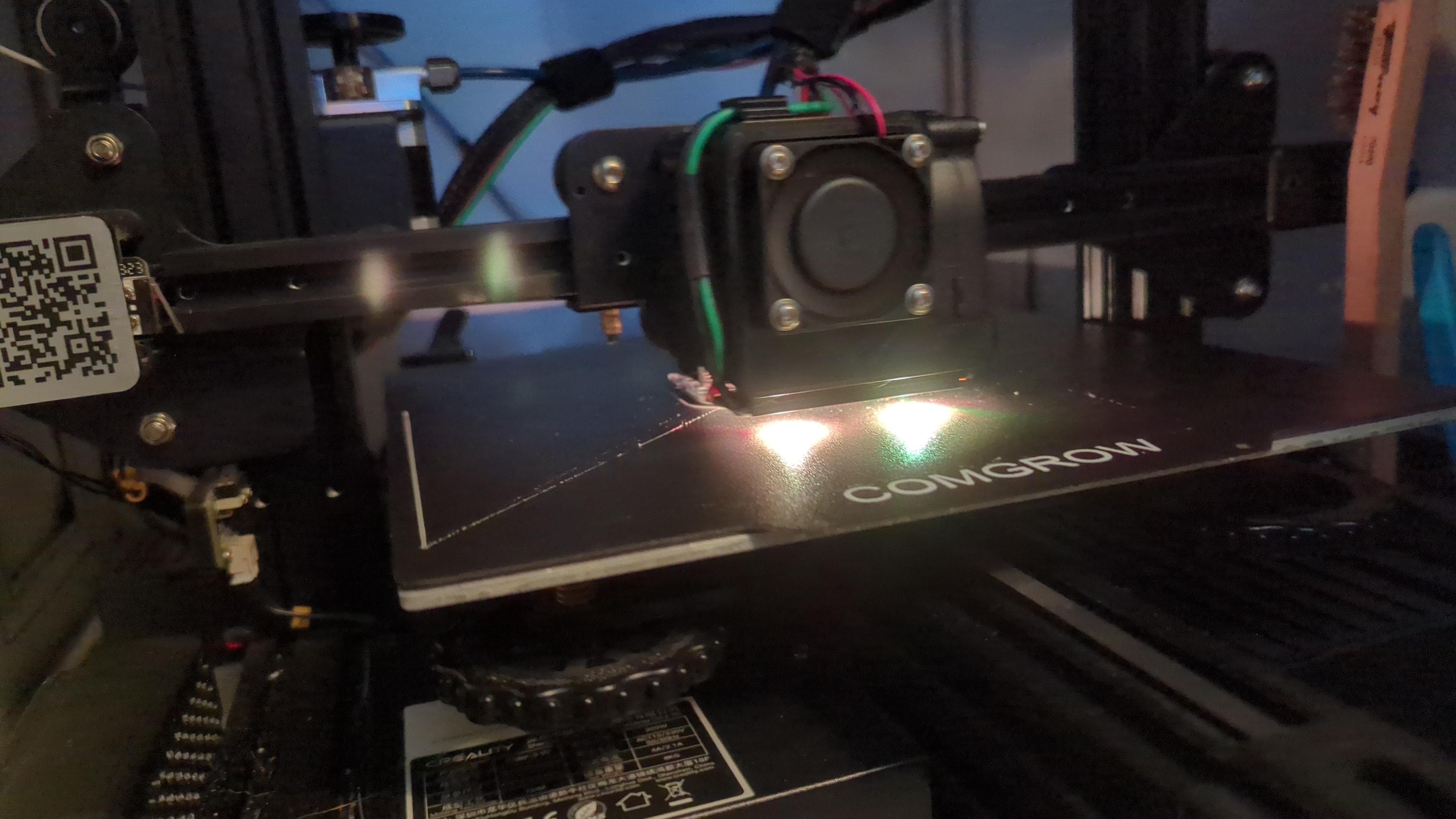 3D printer go brrrr!!! Starting the first (of many) cases.
H1 - A Heltec V3 Device
The first kit I purchased was the Heltec WiFi LoRa 32 V3 which is the same setup used in Muzi Work’s H1. it comes with the board, antenna and pigtail, and a 1200 mAh battery. This board utilizes an ESP32-S3FN8 microprocessor, an SX1262 LoRa chip, a USB-C charging with a voltage regulator and battery interface, WiFi and Bluetooth, and an onboard 128x64 dot matrix OLED display.
This board has become one of the “go-to’s” for Meshtastic and I was excited to try it. I tried it both with the stock antenna as well as the upgrade whip antenna, although I have no supporting data, I did notice an increase range with the whip antenna.
The case was easy to print, but my Ender 3 V2 gave me all kinds of trouble. I finally resolved my adhesion and warping issues and the case came out great. Printing in PLA was not the best idea as I snapped several case’s clasps when taking them apart for modifications. I printed the front of the case in PETG to hopefully avoid this again.
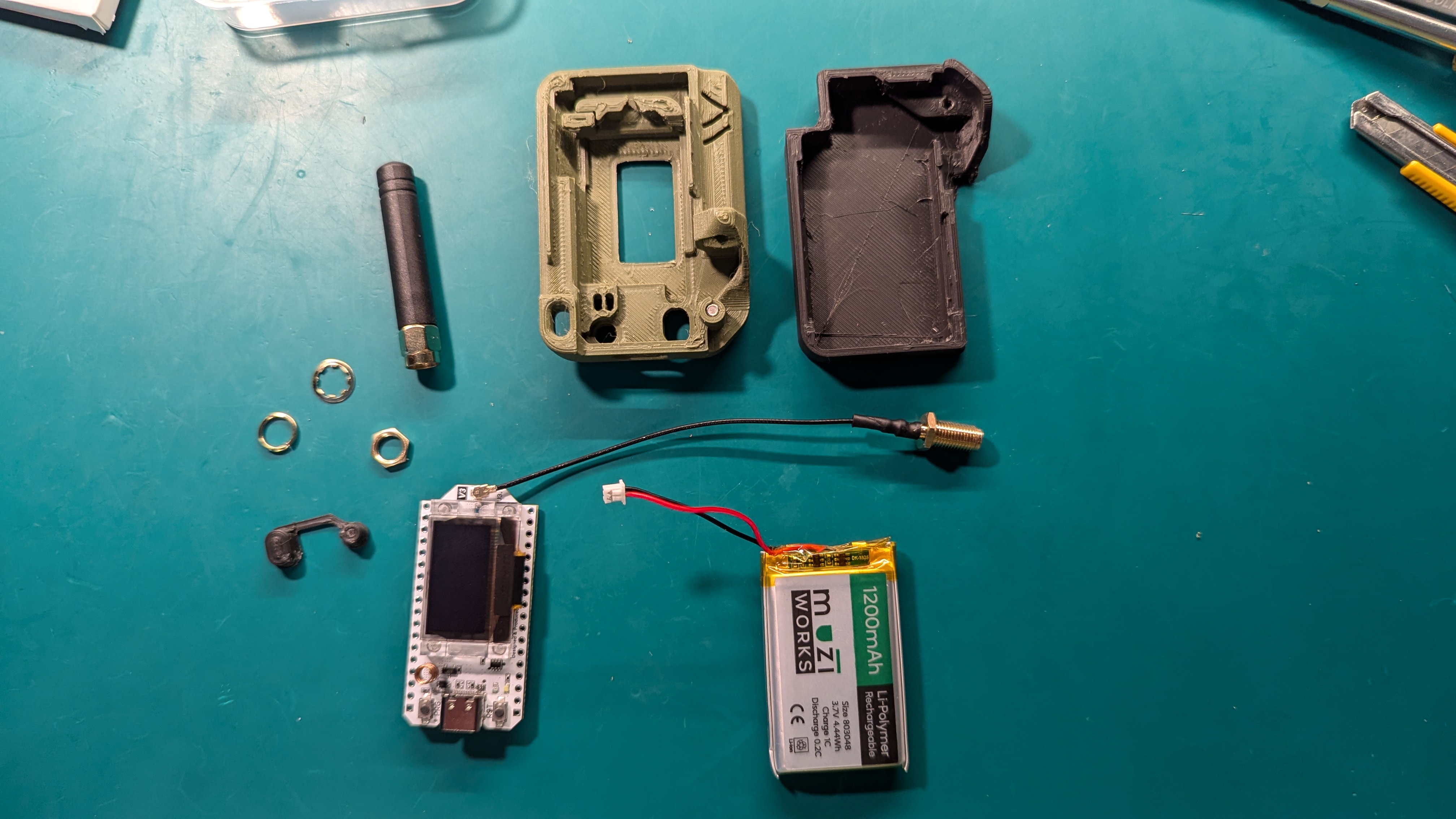 _The H1 with all included parts and case.
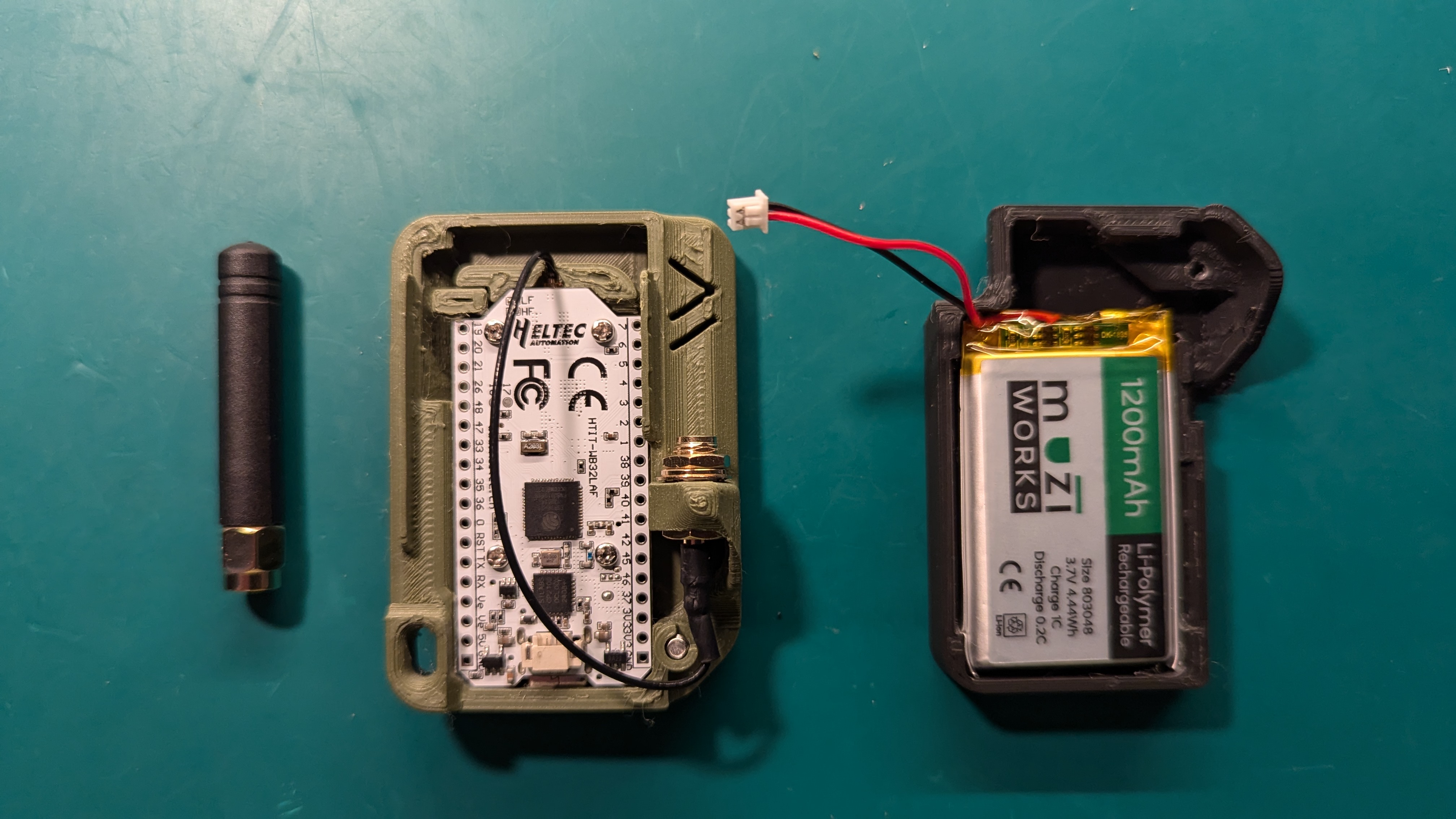 _The H1 with parts installed.
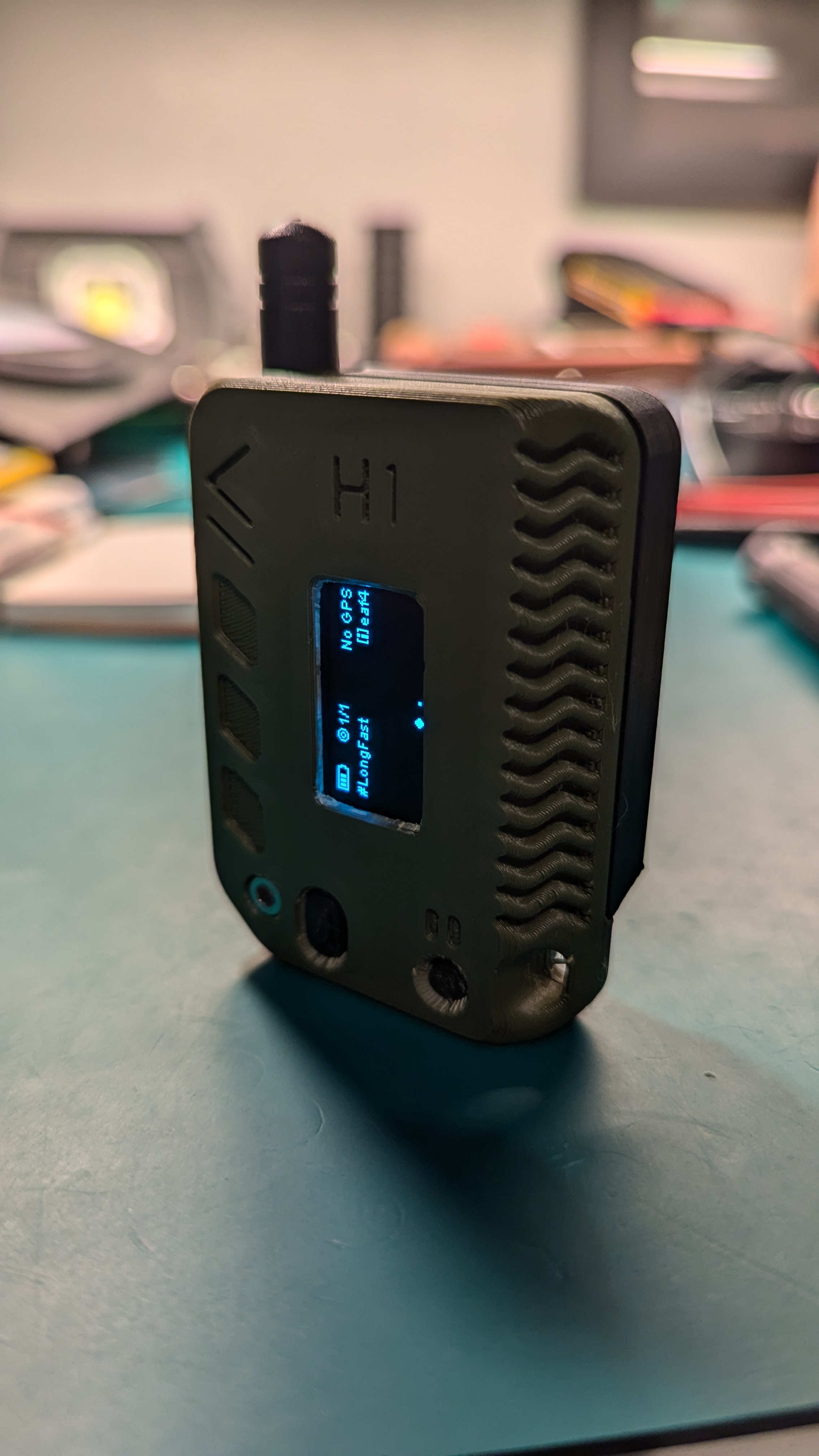 _Front view of the H1.
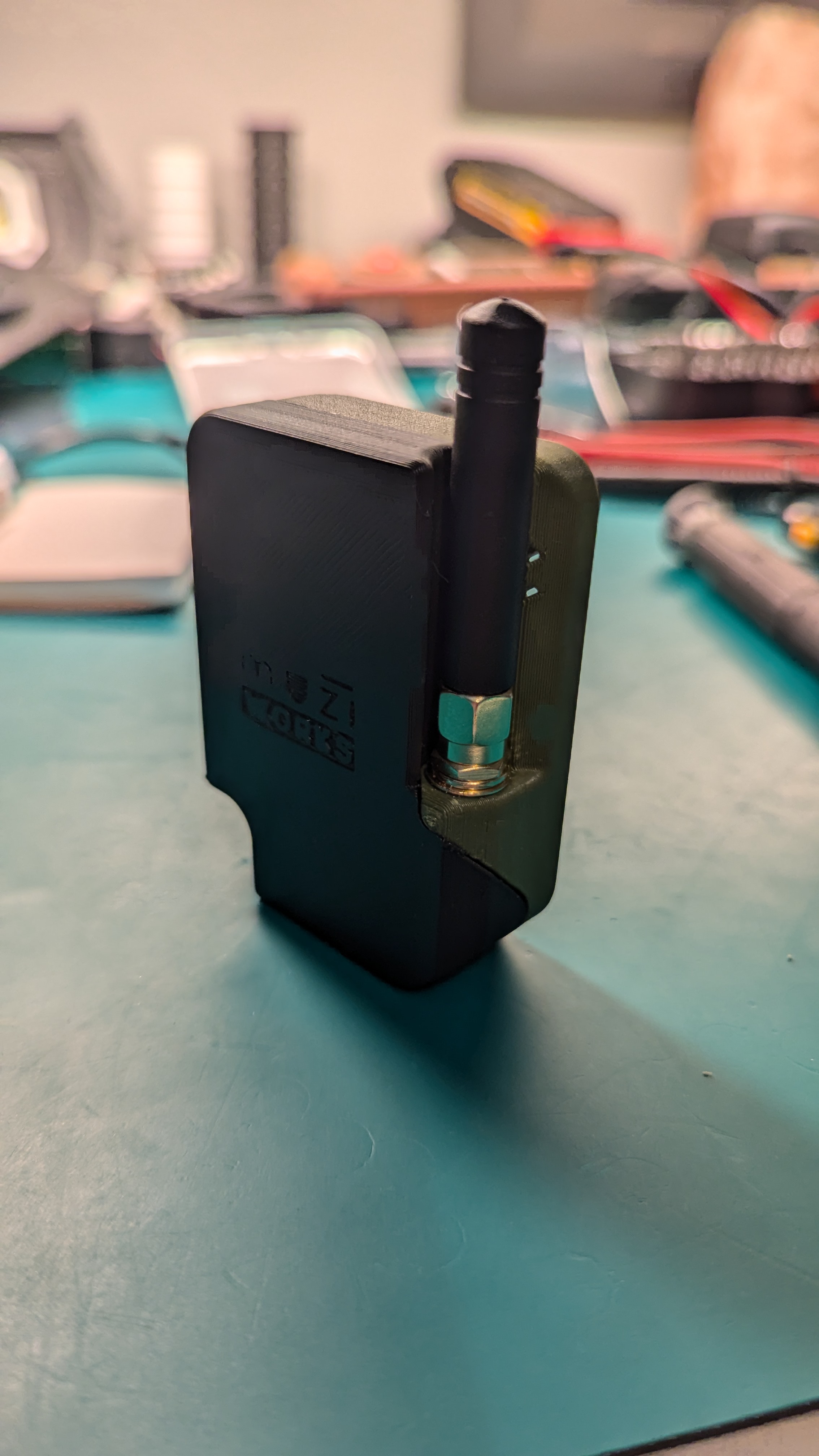 _Rear view of the H1.
H2T - A Heltec T114 Device
The second board I purchased was the Heltec Mesh Node T114.I was extremely excited for this board. It appeared to be an almost successor to the Heltec V3 board. A few differences included a much more power efficient board, a larger 2200 mAh battery, a connector for a solar panel, and a GPS module with dedicated port. This would be perfect to test the GPS capabilities of the devices and and see how that functioned.
The case for this board was a little larger, a little more complicated geometry, and was a little more involved on installation as you have to remove Heltec’s stock plastic and reuse the screws to mount into the 3D printed case. Overall this was a very solid case, although it was a little tight around the GPS module, I even added a heat set insert in the back for a super-secure closure.
I would also be using a whip antenna for this device, but only purchased one for the moment while I test and research upgraded antennas. However, the stubby, stock antenna was very promising.
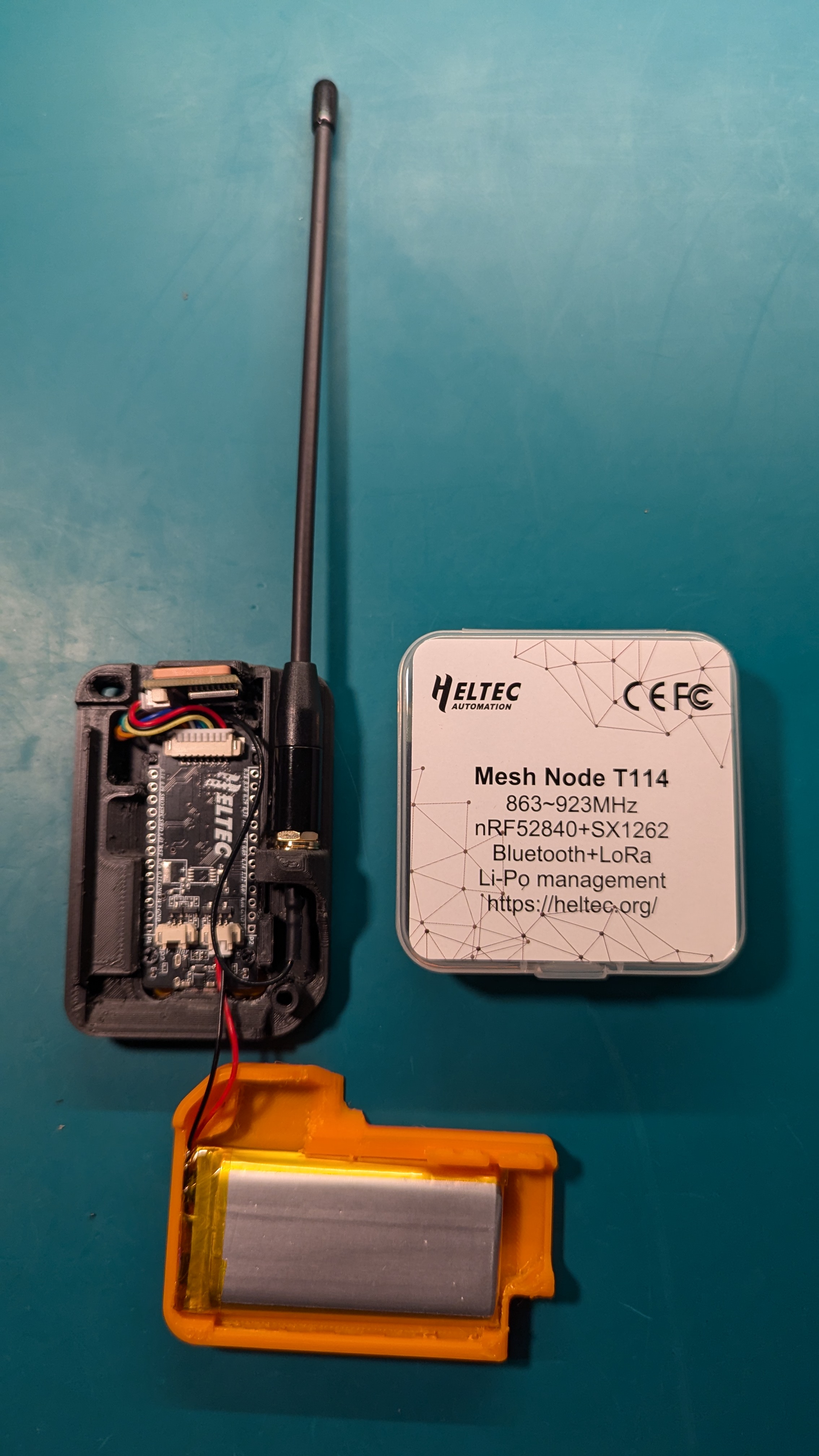 The H2T with parts installed.
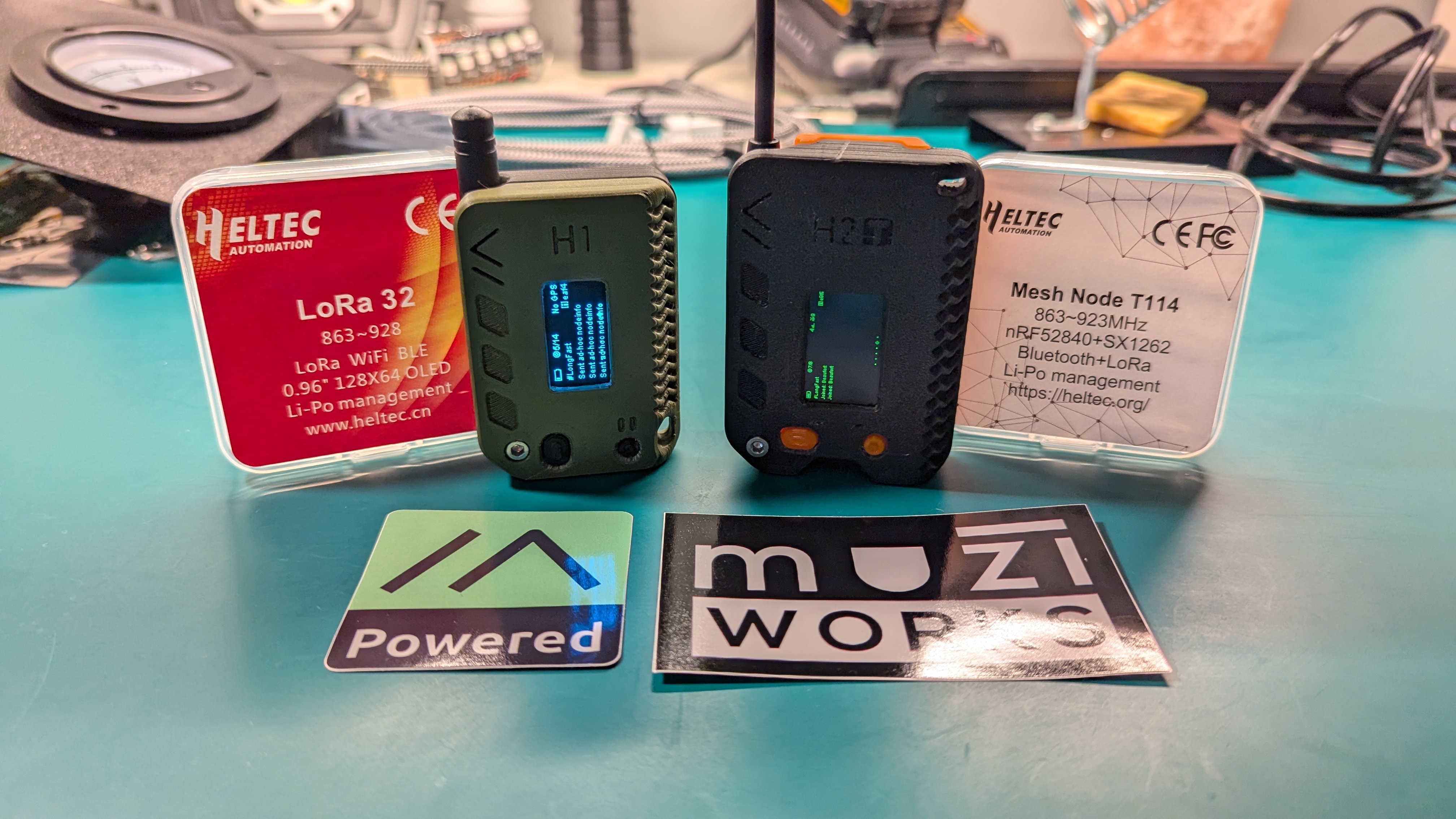 Family Portrait!
Oh no! Troubles already!
Kit chips are NOT pre-flashed!
I guess this should be obvious, but I assumed (I know, I know) that the chips came pre-flashed with Meshtastic and I just had to print the cases, assemble, and power up. I was wrong and wasted waaaaaaaaaay too much time asking: “Why the fuck is this not working?!?!”. I eventually figured it out, and went over to the Official Flasher to actually flash Meshtastic to my new chips. Once this was done I was rocking and rolling.
The H2T was over-promised…
Around a day or two after I first started playing with my new devices I found this Reddit post that crushed some of my dreams. The awesome Heltec T114 has some issues that don’t seem to be fixable at this time. I JUST BOUGHT THIS DAMN BOARD!! Heltec responded to the issues in this GitHub issue thread which provides more technical context if you’re so inclined. But basically, a message over 47 characters or so in length would no send. This could be temporarily resolved by lowering the TX power to 8-10 dBm would solve the issue. There were also issues with Bluetooth connectivity with constant disconnects.
This was not my experience fully though. I never had any issues with Bluetooth, this always functioned as intended although with fairly low range. But, once I tried to send a long message it did not go through and I have still yet to be able to send a successful message since. It appears trying to send a long message has completely borked my brand new Heltec T114 board, I’m so angry. I have tried rebooting and even re-flashing, but I still cannot send messages. Oddly, I do receive messages from my other node, I just can’t transmit from the T114.
How do I fix this?
Fuck the Heltec T114, let’s just use Heltec V3’s
So how do I fix this? Well, for now I’m just going to cut my losses and give up on the Heltec T114…for now. I decided to just purchase another Heltec V3 kit since I know that works without issues. I also realized I could purchase this directly on Amazon instead of Muzi Works’s website which allowed me to get one while Muzi Works was sold out and while getting better shipping through Amazon’s robust monopoly.
I’m not completely giving up hope on the T114. Maybe firmware will be released that solves the issue, or maybe a new version of the board is released that resolves the underlying problem. Either way, I’m out a fairly decent amount or cash but I am not giving up. I will continue to watch for firmware updates, possibly even using my self-hosted changedetection.io instance to be notified of updates automatically.
Next Steps
Solar Node
As I briefly mentioned in the introduction, I am very intrigued by the RAK WisBlock Harbor Breeze mod. It basically takes an inexpensive solar light with plenty of capacity to run a Wisblock Kit completely self-sufficiently. A solar panel, 18650 battery, and battery controller for $15 is a steal. This will probably be the first route I will take with an outdoor node.
Antennas are what are throwing me for a loop. I see several on Rokland and also several on RAK Wireless’s store but its hard to determine if I will benefit from a $100 antenna versus a cheaper $20 antenna. I guess much more research is in my future.
Stealth Nodes
If I can get a self-sufficient solar node up and running, I’m excited for the possibilities following. If I can minimize the footprint of the solar nodes, I could set them up as “set-and-forget” nodes and stealth drop them across the city. I could have a magnet attachment that I could fly onto towers with a drone before dropping and leaving. I could place them strategically on top of buildings throughout the city with roof access. It could be exciting to see how far I can extend a mesh network across the city, especially considering my repeaters would help everyone using the Meshtastic ecosystem, not just myself.
In Review
Overall, I still absolutely love the idea of Meshtastic and I am excited to continue diving in deeper. I am a little salty on the H2T (Heltec T114) fiasco, but if I can get a couple of Heltec V3’s working I’ll be more than happy. The overall goal is to create a robust Meshtastic mesh network covering the city, starting with a repeater node in my backyard, possibly ending with stealth nodes dropped throughout the city. Let’s see where this decentralized, off-grid, open source project takes us.
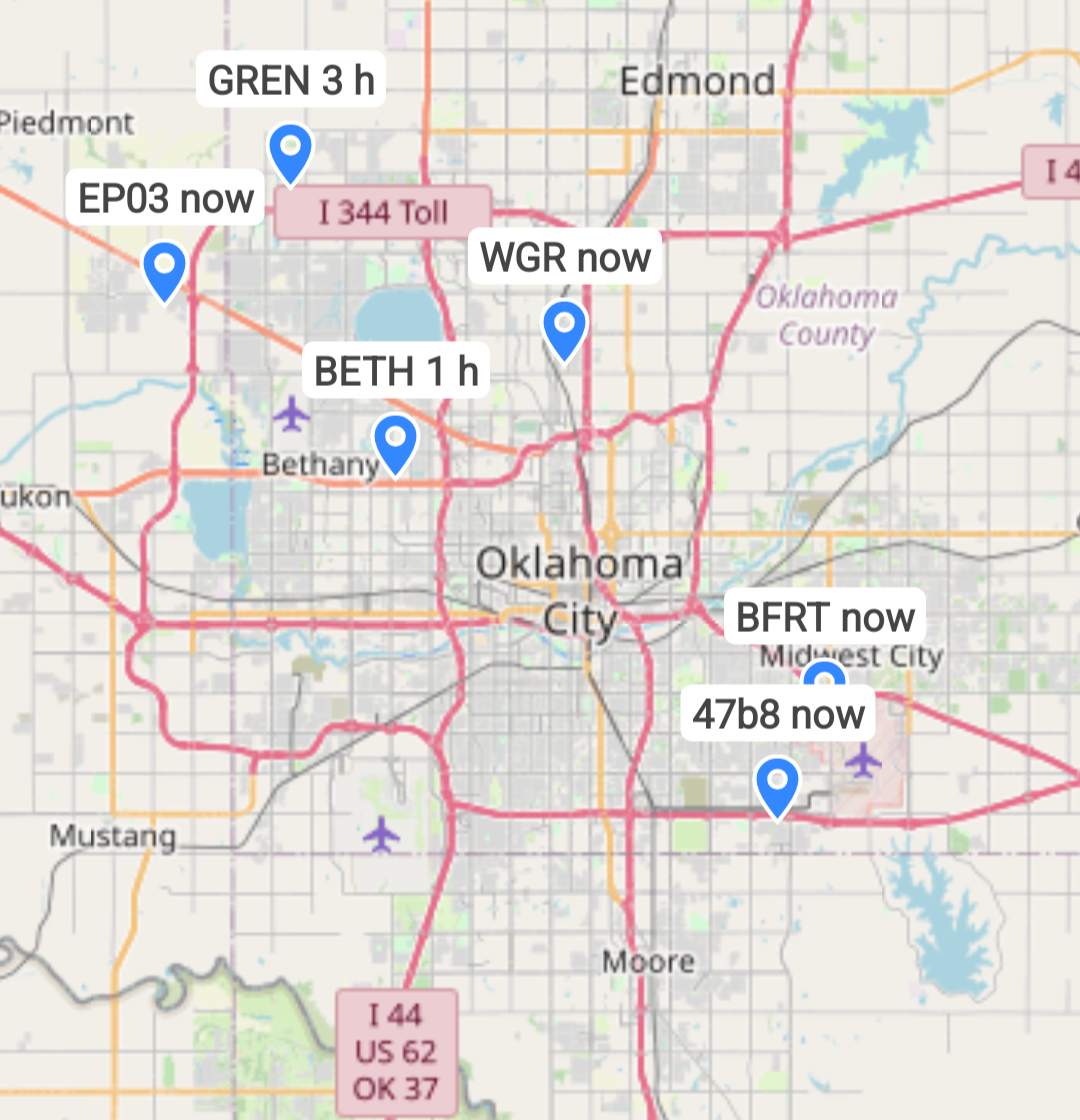 Quite a few nodes across the city!